
On The Word "Quintessence"


In antiquity, Aristotle looked around at the terrestrial realm, a world defined by decay, sickness, and the tragic fragility of flesh and simply refused to accept that the heavens shared this fate. He drew an impenetrable boundary, theorizing that the stars were made of an immutable fifth element, or quinta essentia (aether). It was an intellectual defense mechanism: an attempt to construct a ceiling of perfection over a house of suffering.
Today, we use the word "Quintessence" without much afterthought. You'd be surprised, my dear reader, to know that this word is not just quintessential to our understanding of science, but is a profound chronicle of the relentless human curiosity against the crushing silence of the universe.
"To test whether dark energy is caused by quintessence or the cosmological constant, scientists must determine whether the strength of dark energy has changed over time." —Clara Moskowitz, Scientific American, 1 Feb. 2021

I'm always curious about the origin of words and how they come to mean what they mean today, especially since meanings tend to drift over time. It's utterly fascinating how a word's etymology often presents an unbiased history of the people who have used it.
"Quintessence" is special to me, because it tickles my autism on a few levels [¹]. The evolution of its meaning presents a beautiful chronological account of scientific discoveries. Akin to an ancient palimpsest, where each new generation contributes their own understanding of the universe.
In what follows, we will delve into the different uses throughout history and how the word marked each era.
| Era | The Meaning | The Scientific Paradigm |
|---|---|---|
| c. 350 BC | The Void Filler (Greek: Aither) |
Aristotelian Physics |
| Middle Ages | The Heavenly Extract (Latin: Quinta Essentia) |
Alchemy |
| Late 1500s – 1610 | The Shattered Spheres (The Paradigm Shift) |
The Scientific Revolution |
| 1600s – 1990s | The Literary Metaphor (English: Quintessence) |
Linguistics |
| 1998 – Present | The Accelerating Universe (Modern: Quintessence) |
Theoretical Cosmology |
fig1. The evolution of the meaning of "Quintessence" throughout human history.
Aether
Before Aristotle, the Greeks had a pretty solid working theory of the terrestrial world: everything was made of Earth, Water, Air, and Fire.
But these four earthly elements had strict, observable rules:
- They were messy: They constantly mixed, changed, decayed, and destroyed each other.
- They moved in straight lines: Earth and Water naturally fell down toward the center of the universe. Air and Fire naturally rose up away from it.
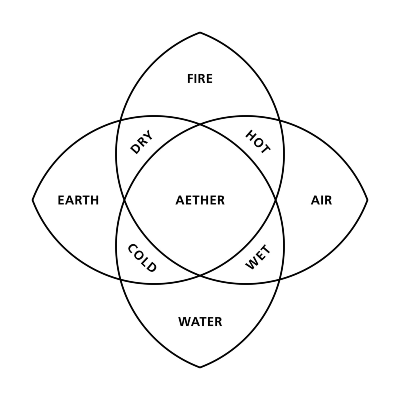
The problem was when they looked up at the night sky. The stars and planets completely violated terrestrial physics. They didn't fall down, they didn't rise up, and they didn't burn out or decay. They moved in perfect, eternal, unchanging circles.
The Solution: Aither (The Patch for the Physics Engine)
To save their model of the universe, Aristotle and his contemporaries had to invent a patch. If the heavens didn't act like Earth, Water, Air, or Fire, they must be made of a completely different, completely alien substance.
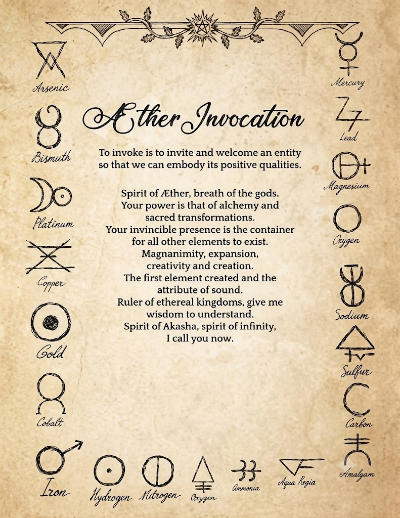
They called it Aither (often translated as aether or ether). Later, when the Romans translated Greek texts, they literally just called it the "fifth element" or quinta essentia in Latin.
Aristotle assigned very specific, god-tier properties to Aither to make his physics work:
- Circular Motion: Unlike earthly elements that moved in straight lines, Aither naturally moved in perfect circles. This explained why the stars orbited endlessly without needing an engine to push them.
- Immutable: It could not be created, destroyed, or altered. It was eternally locked in its current state. No decay, no aging.
- Weightless: It had absolutely no mass. It was neither heavy nor light. It doesn't fall down or rise up.
- The Void Filler: Aristotle believed a true vacuum was physically impossible ("nature abhors a vacuum"). Since the space between the stars couldn't be empty, it had to be packed solid with Aither. It was the invisible scaffolding of the universe.
The Etymological Roots
The word "Aither" originally came from a Greek root meaning "to ignite" or "to burn," but in ancient Greek mythology, it referred to the pure, crystalline air breathed by the gods on Mount Olympus, as opposed to the thick, murky air (aer) breathed by mortals.
Aristotle stripped away the mythology and turned it into hard physics. For the next 2,000 years, this wasn't poetry, this was the accepted and undisputed scientific fact of how outer space worked.
Medicinal Alchemy and Elixirs
By the Middle Ages, this desperate need to conquer decay moved from the sky into the soot-stained laboratories of the alchemists. Alchemists began to theorize that tiny, hidden amounts of this celestial material existed within all things on Earth.
By the 14th and 15th centuries, the pursuit of aether became the foundation of medicinal alchemy. The logic was straightforward: since aether was heavenly and incorruptible, consuming it would purge the human body of illness and impurity, effectively restoring the body to a state of perfection.
Surrounded by the Black Death, men like the Franciscan friar John of Rupescissa sought this very mission. They believed that by distilling wine enough times to extract its aqua ardens (the water of life), they could isolate the "quintessence". They were not just doing chemistry; they were trying to bottle the cure to human fragility.
This relentless pursuit is actually how highly distilled spirits and concentrated essential oils first became prominent in medicine.
The Philosopher's Stone
Over time, the isolated quintessence became virtually synonymous with the Philosopher's Stone and the Elixir of Life, the ultimate catalysts capable of transmuting base metals into gold and mortal bodies into immortal ones.
The Scientific Revolution
Even as the mystical alembics of Ibn Hayyan gave way to the rigorous mathematics of the Enlightenment, the terror of the void remained.
Thinkers like Descartes filled the universe with a cosmic fluid because the idea of truly empty space was philosophically unbearable. Even Isaac Newton, the ultimate cold rationalist, confronted by gravity pulling across millions of miles of nothingness, he hypothesized a "subtle spirit" because he simply could not endure the silence.
"The eternal silence of these infinite spaces frightens me." — Blaise Pascal, Pensées
In 1577, Tycho Brahe observed a comet smashing straight through the Aristotelian aether-made spheres that carried the planets. The crystalline sky shattered. The heavens were fluid, but a fluid made of what?
Huygens and the Light-Bearing Ocean
As the Scientific Revolution progressed, the aether shifted from a philosophical necessity to an engineering requirement. Christiaan Huygens realized that if light was a wave, it needed a medium to wave through.
In his 1690 Traité de la Lumière, Huygens introduced the luminiferous aether, a specialized, highly elastic, frictionless medium filling all of space. This turned the aether into strict mechanical infrastructure. Just as sound required air to travel, light required aether.
Newton's Cognitive Dissonance
Isaac Newton's mathematical models worked perfectly in a vacuum. His Principia (1687) proved that if the universe was full of fluid, planets would experience drag and eventually spiral into the sun. Newton's physics worked best if space was a total, silent void.
Newton, however, philosophically hated his own mathematical conclusion. In a 1692 letter to Richard Bentley, he wrote that action at a distance was:
"So great an Absurdity that I believe no Man who has in philosophical Matters a competent Faculty of thinking can ever fall into it." — Isaan Newton
In the queries at the end of his later book, Opticks, Newton caved. He proposed an aether that was incredibly rare but varied in density: thinner near massive bodies and denser in deep space, thus creating a pressure gradient that physically pushed planets together.
Modern Astrophysics
Today, our telescopes have pierced further into the dark, and what we have found is terrifying. In 1998, we discovered that the universe is not just expanding; it is accelerating, plunging faster and faster into the cold dark. To explain this anti-gravitational terror, modern astrophysics has posited a dynamic, time-varying scalar field as an alternative to a flat, unchanging cosmological constant.
They named it, once again, Quintessence.
[1] Just kidding, I'm not autistic.
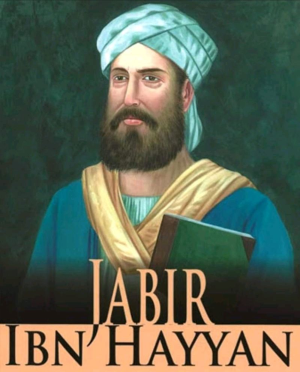
[2] Abū Mūsā Jābir ibn Ḥayyān (known in the West as Geber) was an 8th-century polymath widely celebrated as the father of early chemistry. He transformed mystical alchemy into an experimental science by pioneering fundamental laboratory techniques, discovering major mineral acids, and introducing the influential sulfur-mercury theory of metals.